
SYSTEMS
The 33 systems of reality, stemming from attention, language, identity, power, markets, and belief.
The 33 systems of reality, stemming from attention, language, identity, power, markets, and belief.
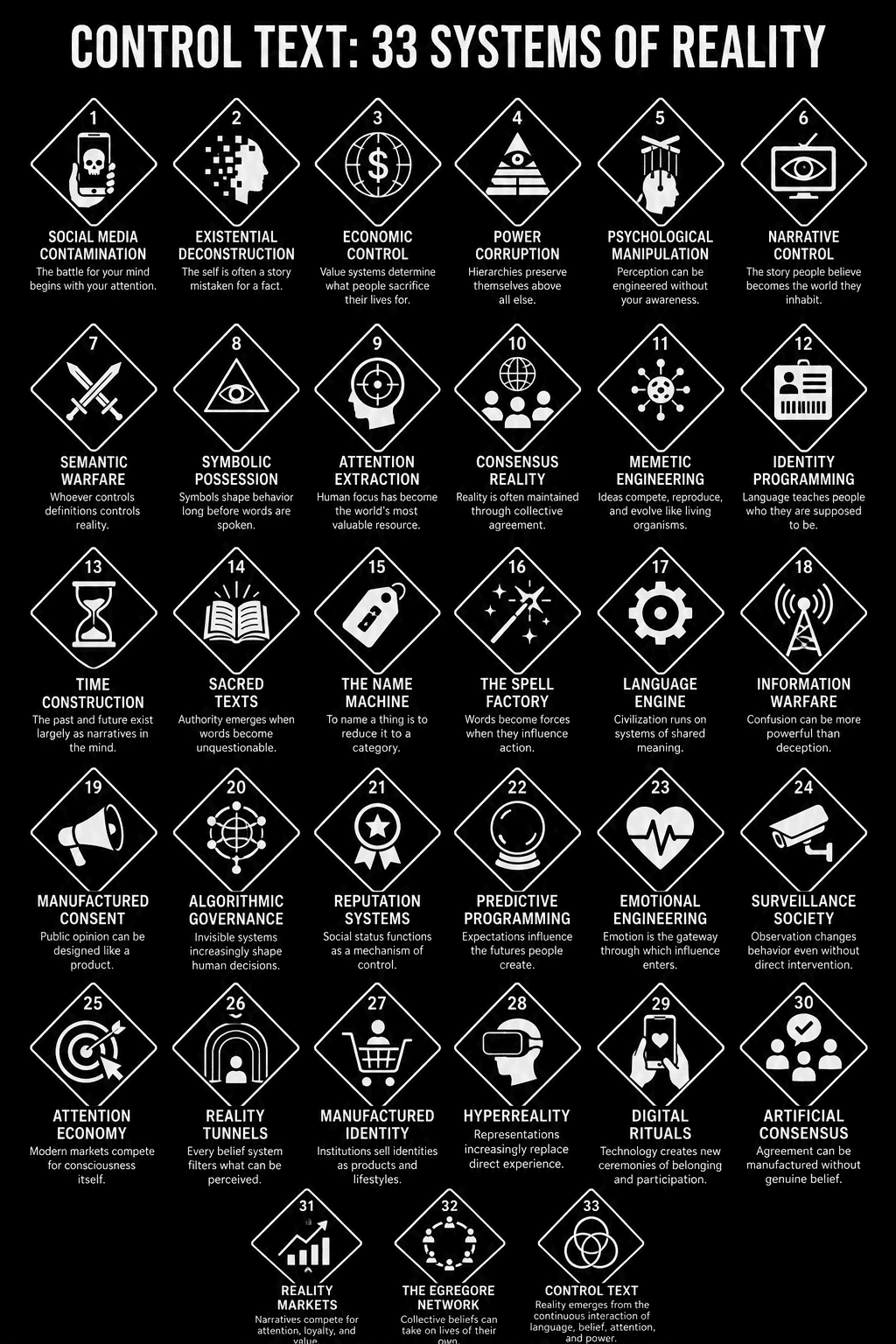
CONTROL TEXT: 33 SYSTEMS OF REALITY
1. Social Media Contamination — The battle for your mind begins with your attention.
2. Existential Deconstruction — The self is often a story mistaken for a fact.
3. Economic Control — Value systems determine what people sacrifice their lives for.
4. Power Corruption — Hierarchies preserve themselves above all else.
5. Psychological Manipulation — Perception can be engineered without your awareness.
6. Narrative Control — The story people believe becomes the world they inhabit.
7. Semantic Warfare — Whoever controls definitions controls reality
8. Symbolic Possession — Symbols shape behavior long before words are spoken.
9. Attention Extraction — Human focus has become the world’s most valuable resource.
10. Consensus Reality — Reality is often maintained through collective agreement.
11. Memetic Engineering — Ideas compete, reproduce, and evolve like living organisms.
12. Identity Programming — Language teaches people who they are supposed to be.
13. Time Construction — The past and future exist largely as narratives in the mind.
14. Sacred Texts — Authority emerges when words become unquestionable.
15. The Name Machine — To name a thing is to reduce it to a category.
16. The Spell Factory — Words become forces when they influence acion.
17. Language Engine — Civilization runs on systems of shared meaning.
18. Information Warfare — Confusion can be more powerful than deception.
19. Manufactured Consent — Public opinion can be designed like a product.
20. Algorithmic Governance — Invisible systems increasingly shape human decisions.
21. Reputation Systems — Social status functions as a mechanism of control.
22. Predictive Programming — Expectations influence the futures people create.
23. Emotional Engineering — Emotion is the gateway through which influence enters.
24. Surveillance Society — — Observation changes behavior even without direct intervention.
25. Attention Economy — Modern markets compete for consciousness itself.
26. Reality Tunnels — Every belief system filters what can be perceived.
27. Manufactured Identity — Institutions sell identities as products and lifestyles.
28. Hyperreality — Representations increasingly replace direct experience.
29. Digital Rituals — Technology creates new ceremonies of belonging and participation.
30. Artificial Consensus — Agreement can be manufactured without genuine belief.
31. Reality Markets — Narratives compete for attention, loyalty, and value.
32. The Egregore Network — Collective beliefs can take on lives of their own.
33. CONTROL TEXT — Reality emerges from the continuous interaction of
CONTROL TEXT: 33 SYSTEMS OF REALITY
1. Social Media Contamination — The battle for your mind begins with your attention.
2. Existential Deconstruction — The self is often a story mistaken for a fact.
3. Economic Control — Value systems determine what people sacrifice their lives for.
4. Power Corruption — Hierarchies preserve themselves above all else.
5. Psychological Manipulation — Perception can be engineered without your awareness.
6. Narrative Control — The story people believe becomes the world they inhabit.
7. Semantic Warfare — Whoever controls definitions controls reality
8. Symbolic Possession — Symbols shape behavior long before words are spoken.
9. Attention Extraction — Human focus has become the world’s most valuable resource.
10. Consensus Reality — Reality is often maintained through collective agreement.
11. Memetic Engineering — Ideas compete, reproduce, and evolve like living organisms.
12. Identity Programming — Language teaches people who they are supposed to be.
13. Time Construction — The past and future exist largely as narratives in the mind.
14. Sacred Texts — Authority emerges when words become unquestionable.
15. The Name Machine — To name a thing is to reduce it to a category.
16. The Spell Factory — Words become forces when they influence acion.
17. Language Engine — Civilization runs on systems of shared meaning.
18. Information Warfare — Confusion can be more powerful than deception.
19. Manufactured Consent — Public opinion can be designed like a product.
20. Algorithmic Governance — Invisible systems increasingly shape human decisions.
21. Reputation Systems — Social status functions as a mechanism of control.
22. Predictive Programming — Expectations influence the futures people create.
23. Emotional Engineering — Emotion is the gateway through which influence enters.
24. Surveillance Society — — Observation changes behavior even without direct intervention.
25. Attention Economy — Modern markets compete for consciousness itself.
26. Reality Tunnels — Every belief system filters what can be perceived.
27. Manufactured Identity — Institutions sell identities as products and lifestyles.
28. Hyperreality — Representations increasingly replace direct experience.
29. Digital Rituals — Technology creates new ceremonies of belonging and participation.
30. Artificial Consensus — Agreement can be manufactured without genuine belief.
31. Reality Markets — Narratives compete for attention, loyalty, and value.
32. The Egregore Network — Collective beliefs can take on lives of their own.
33. CONTROL TEXT — Reality emerges from the continuous interaction of
THE 33 SYSTEMS
+
Individual - Conditioning DOMAIN
1. Social Media Contamination
Hazard: Attention Contamination Class: SOC-01
Dopamine loops
Algorithmic addiction
Identity fragmentation
Digital dependency
System Weak Point: Attention can be reclaimed.
2. Existential Deconstruction
Hazard: Meaning Collapse Class: EXS-01
Self illusion
Identity breakdown
Meaning crisis
Awakening
System Weak Point: Awareness survives every story.
3. Economic Control
Hazard: Value Extraction Class: ECO-01
Debt
Scarcity
Labor exploitation
Wealth concentration
System Weak Point: Systems depend on participation.
4. Power Corruption
Hazard: Hierarchical Capture Class: SYS-01
Authority
Compliance
Enforcement
Dependency
System Weak Point: Power exists through consent.
5. Psychological Manipulation
Hazard: Cognitive Reprogramming Class: PSY-01
Conditioning
Emotional leverage
Behavior shaping
Perception control
System Weak Point: Awareness interrupts programming.
6. Narrative Control
Hazard: Story Domination Class: NAR-01
Framing
Editing
Distribution
Belief installation
System Weak Point: Truth exists outside the story.
+
Language DOMAIN
7. Semantic Warfare
Hazard: Meaning Manipulation Class: SEM-01
Control definitions. Control reality.
System Weak Point: Meaning requires agreement.
8. Symbolic Possession
Hazard: Archetypal Infection Class: ARC-01
Symbols become identities.
System Weak Point: Symbols only possess the unconscious.
9. Attention Extraction
Hazard: Cognitive Harvesting Class: ATT-01
Attention becomes currency.
System Weak Point: Attention can be withdrawn.
10. Consensus Reality
Hazard: Collective Hallucination Class: CON-01
Reality emerges from agreement.
System Weak Point: Consensus can shift.
11. Memetic Engineering
Hazard: Thought Virus Class: MEM-01
Ideas evolve like organisms.
System Weak Point: Awareness breaks replication.
12. Identity Programming
Hazard: Self Construction Class: IDN-01
Language builds identity.
System Weak Point: The observer precedes the label.
13. Time Construction
Hazard: Temporal Conditioning Class: TMP-01
Language creates past and future.
System Weak Point: Only the present is experienced.
14. Sacred Texts
Hazard: Authority Encoding Class: TXT-01
Words become unquestionable.
System Weak Point: All texts require interpretation.
15. The Name Machine
Hazard: Categorization Control Class: NAM-01
To name is to define.
System Weak Point: Reality exceeds categories.
16. The Spell Factory
Hazard: Linguistic Sorcery Class: LNG-01
Words become reality programs.
System Weak Point: Spells fail when exposed.
17. Language Engine
Hazard: Reality Generation Class: CTX-00
Language generates civilization.
System Weak Point: Experience exists before language.
+
The Signal DOMAIN
18. Information Warfare
Hazard: Signal Obfuscation Class: INF-01
Confuse reality through noise.
System Weak Point: Signal survives distortion.
19. Manufactured Consent
Hazard: Opinion Engineering Class: POL-01
Public opinion as a product.
System Weak Point: Consent can be withdrawn.
20. Algorithmic Governance
Hazard: Invisible Guidance Class: ALG-01
Machines shape decisions.
System Weak Point: Algorithms require inputs.
21. Reputation Systems
Hazard: Social Scoring Class: REP-01
Behavior through status.
System Weak Point: Authenticity ignores ranking.
22. Predictive Programming
Hazard: Future Conditioning Class: PRD-01
Stories shape expectations.
System Weak Point: The future remains unwritten.
23. Emotional Engineering
Hazard: Feeling Manipulation Class: EMO-01
Control emotion. Control action.
System Weak Point: Emotion observed loses control.
24. Surveillance Society
Hazard: Behavioral Monitoring Class: SUR-01
Observation becomes influence.
System Weak Point: Watching is not understanding.
25. Attention Economy
Hazard: Human Resource Extraction Class: AEC-01
Monetized consciousness.
System Weak Point: Presence cannot be bought.
+
The Simulation DOMAIN
26. Reality Tunnels
Hazard: Perception Filtering Class: RTL-01
People inhabit different realities.
System Weak Point: Multiple perspectives exist.
27. Manufactured Identity
Hazard: Synthetic Selfhood Class: MID-01
Identity as a consumer product.
System Weak Point: Identity is fluid.
28. Hyperreality
Hazard: Simulation Dominance Class: HYP-01
Representation replaces reality.
System Weak Point: Reality remains underneath.
29. Digital Rituals
Hazard: Technological Enchantment Class: DIG-01
Modern ceremonies of engagement.
System Weak Point: Rituals require repetition.
30. Artificial Consensus
Hazard: Synthetic Agreement Class: SYN-01
Bots manufacture belief.
System Weak Point: Truth does not require volume.
31. Reality Markets
Hazard: Belief Commodification Class: RLM-01
Narratives compete for value.
System Weak Point: Reality is not a commodity.
32. The Egregore Network
Hazard: Collective Thought Forms Class: EGR-01
Ideas become autonomous systems.
System Weak Point: Egregores require attention to survive.
+
The Source DOMAIN
33. CONTROL TEXT
Hazard: Reality Architecture Class: CTX-33
The Master Diagram.
Everything feeds into:
Language
Symbols
Narratives
Attention
Identity
Emotion
Economics
Technology
Belief
Power
The machine outputs:
Governments
Religions
Markets
Cultures
Histories
Identities
Futures
At the center:
+
RAW EXPERIENCE
+
THE 33 SYSTEMS
+
Individual - Conditioning DOMAIN
Social Media Contamination
Hazard: Attention Contamination Class: SOC-01
Dopamine loops
Algorithmic addiction
Identity fragmentation
Digital dependency
System Weak Point: Attention can be reclaimed.
Existential Deconstruction
Hazard: Meaning Collapse Class: EXS-01
Self illusion
Identity breakdown
Meaning crisis
Awakening
System Weak Point: Awareness survives every story.
Economic Control
Hazard: Value Extraction Class: ECO-01
Debt
Scarcity
Labor exploitation
Wealth concentration
System Weak Point: Systems depend on participation.
Power Corruption
Hazard: Hierarchical Capture Class: SYS-01
Authority
Compliance
Enforcement
Dependency
System Weak Point: Power exists through consent.
Psychological Manipulation
Hazard: Cognitive Reprogramming Class: PSY-01
Conditioning
Emotional leverage
Behavior shaping
Perception control
System Weak Point: Awareness interrupts programming.
Narrative Control
Hazard: Story Domination Class: NAR-01
Framing
Editing
Distribution
Belief installation
System Weak Point: Truth exists outside the story.
+
Language DOMAIN
Semantic Warfare
Hazard: Meaning Manipulation Class: SEM-01
Control definitions. Control reality.
System Weak Point: Meaning requires agreement.
Symbolic Possession
Hazard: Archetypal Infection Class: ARC-01
Symbols become identities.
System Weak Point: Symbols only possess the unconscious.
Attention Extraction
Hazard: Cognitive Harvesting Class: ATT-01
Attention becomes currency.
System Weak Point: Attention can be withdrawn.
Consensus Reality
Hazard: Collective Hallucination Class: CON-01
Reality emerges from agreement.
System Weak Point: Consensus can shift.
Memetic Engineering
Hazard: Thought Virus Class: MEM-01
Ideas evolve like organisms.
System Weak Point: Awareness breaks replication.
Identity Programming
Hazard: Self Construction Class: IDN-01
Language builds identity.
System Weak Point: The observer precedes the label.
Time Construction
Hazard: Temporal Conditioning Class: TMP-01
Language creates past and future.
System Weak Point: Only the present is experienced.
Sacred Texts
Hazard: Authority Encoding Class: TXT-01
Words become unquestionable.
System Weak Point: All texts require interpretation.
The Name Machine
Hazard: Categorization Control Class: NAM-01
To name is to define.
System Weak Point: Reality exceeds categories.
The Spell Factory
Hazard: Linguistic Sorcery Class: LNG-01
Words become reality programs.
System Weak Point: Spells fail when exposed.
Language Engine
Hazard: Reality Generation Class: CTX-00
Language generates civilization.
System Weak Point: Experience exists before language.
+
The Signal DOMAIN
Information Warfare
Hazard: Signal Obfuscation Class: INF-01
Confuse reality through noise.
System Weak Point: Signal survives distortion.
Manufactured Consent
Hazard: Opinion Engineering Class: POL-01
Public opinion as a product.
System Weak Point: Consent can be withdrawn.
Algorithmic Governance
Hazard: Invisible Guidance Class: ALG-01
Machines shape decisions.
System Weak Point: Algorithms require inputs.
Reputation Systems
Hazard: Social Scoring Class: REP-01
Behavior through status.
System Weak Point: Authenticity ignores ranking.
Predictive Programming
Hazard: Future Conditioning Class: PRD-01
Stories shape expectations.
System Weak Point: The future remains unwritten.
Emotional Engineering
Hazard: Feeling Manipulation Class: EMO-01
Control emotion. Control action.
System Weak Point: Emotion observed loses control.
Surveillance Society
Hazard: Behavioral Monitoring Class: SUR-01
Observation becomes influence.
System Weak Point: Watching is not understanding.
Attention Economy
Hazard: Human Resource Extraction Class: AEC-01
Monetized consciousness.
System Weak Point: Presence cannot be bought.
+
The Simulation DOMAIN
Reality Tunnels
Hazard: Perception Filtering Class: RTL-01
People inhabit different realities.
System Weak Point: Multiple perspectives exist.
Manufactured Identity
Hazard: Synthetic Selfhood Class: MID-01
Identity as a consumer product.
System Weak Point: Identity is fluid.
Hyperreality
Hazard: Simulation Dominance Class: HYP-01
Representation replaces reality.
System Weak Point: Reality remains underneath.
Digital Rituals
Hazard: Technological Enchantment Class: DIG-01
Modern ceremonies of engagement.
System Weak Point: Rituals require repetition.
Artificial Consensus
Hazard: Synthetic Agreement Class: SYN-01
Bots manufacture belief.
System Weak Point: Truth does not require volume.
Reality Markets
Hazard: Belief Commodification Class: RLM-01
Narratives compete for value.
System Weak Point: Reality is not a commodity.
The Egregore Network
Hazard: Collective Thought Forms Class: EGR-01
Ideas become autonomous systems.
System Weak Point: Egregores require attention to survive.
+
The Source DOMAIN
CONTROL TEXT
Hazard: Reality Architecture Class: CTX-33
The Master Diagram.
Everything feeds into:
Language
Symbols
Narratives
Attention
Identity
Emotion
Economics
Technology
Belief
Power
The machine outputs:
Governments
Religions
Markets
Cultures
Histories
Identities
Futures
At the center:
+
RAW EXPERIENCE
+
"The world is written
before it is built."
