
RESEARCH
CONTROL TEXT – CITED SOURCES
By: Warren Peterson
This framework synthesizes concepts from systems theory, psychology, cybernetics, media studies, behavioral economics, philosophy, and symbolic analysis.
Marshall McLuhan — Understanding Media
Michel Foucault — surveillance/power structures
Carl Jung — symbolic systems/archetypes
Jean Baudrillard — hyperreality/media simulation
Noam Chomsky & Edward Bernays — media influence/propaganda
Daniel Kahneman — cognitive bias/behavior
Friedrich Nietzsche — existential philosophy
Systems Theory / Cybernetics
Behavioral Psychology
Information Theory
Works Referenced
Baudrillard, Jean. Simulacra and Simulation.
Foucault, Michel. Discipline and Punish.
Kahneman, Daniel. Thinking, Fast and Slow.
McLuhan, Marshall. Understanding Media.
Debord, Guy. Society of the Spectacle.
Jung, Carl. Man and His Symbols.
Bernays, Edward. Propaganda.
Skinner, B.F. Science and Human Behavior.
Symbolic Sources & Origin
BEHAVIORAL LOOP (PSYCHOLOGICAL)
¹ Related concepts include operant conditioning (B.F. Skinner), habit loops in behavioral psychology, reinforcement learning, and cyclical behavioral pattern theory.
CONDITIONED RESPONSE
¹ Influenced by classical conditioning theory (Ivan Pavlov), operant conditioning (B.F. Skinner), and behavioral adaptation models within psychology and neuroscience.
EXTERNAL VALIDATION
¹ Related to social approval theory, identity reinforcement systems, social comparison theory (Leon Festinger), and reward-processing research in psychology.
IDENTITY ATTACHMENT
¹ Related concepts include ego identification (Carl Jung), social identity theory, symbolic interactionism, and attachment between self-perception and external structure.
LEARNED BELIEF
¹ Influenced by social conditioning theory, memetics, cognitive schema formation, cultural transmission models, and ideological reinforcement systems.
PASSIVE ACCEPTANCE
¹ Related to learned helplessness (Martin Seligman), normalization processes, conformity studies, and institutional adaptation theory.
PERCEIVED CONTROL
¹ Related concepts include locus of control theory, cognitive stability mechanisms, uncertainty reduction theory, and behavioral predictability research.
PERCEIVED REALITY
¹ Influenced by phenomenology, cognitive psychology, media theory, perceptual filtering, and simulation/hyperreality concepts (Jean Baudrillard).
PERFORMATIVE BEHAVIOR
¹ Related to social performance theory (Erving Goffman), identity signaling, audience conditioning, and digitally mediated self-presentation systems.
POP PSYCHOLOGY
¹ Influenced by critiques of simplified behavioral frameworks, mass-media psychology, diagnostic popularization, and reductionist interpretation models.
AMPLIFIED RHETORIC (NARRATIVE)
¹ Related concepts include propaganda theory, emotional framing, persuasive communication systems, and mass-media amplification structures.
PLAUSIBLE DENIABILITY
¹ Associated with intelligence operations theory, compartmentalization structures, political ambiguity mechanisms, and legal liability distancing.
CONTROLLED NARRATIVE
¹ Influenced by media framing theory, agenda-setting theory, propaganda analysis (Edward Bernays), and information control systems.
POLITICAL NARRATIVE
¹ Related to ideological framing, mass persuasion, political communication theory, and symbolic construction of legitimacy.
SELECTIVE FRAMING
¹ Influenced by framing theory in media studies, contextual bias research, and perception management systems.
DIVISIVE STORYLINES
¹ Related concepts include polarization theory, tribal identity reinforcement, conflict-based media engagement, and adversarial narrative construction.
NARRATIVE REPETITION
¹ Associated with the illusory truth effect, propaganda repetition systems, memetic reinforcement, and cognitive familiarity bias.
WEALTH ACCUMULATION (ECONOMIC)
¹ Related to capital accumulation theory, compounding economic systems, ownership structures, and concentration of financial leverage.
RESOURCE EXTRACTION
¹ Influenced by industrial economics, extraction theory, ecological systems analysis, and resource dependency models.
DISPARITY OF WEALTH
¹ Related concepts include economic inequality theory, wealth concentration dynamics, class stratification, and resource distribution systems.
VALUE ASSIGNMENT
¹ Influenced by subjective value theory, symbolic economics, social valuation systems, and scarcity-based pricing mechanisms.
MARKET DEPENDENCE
¹ Related to market systems theory, economic participation dependency, labor commodification, and consumption-based continuity models.
FINANCIAL PRESSURE
¹ Influenced by behavioral economics, scarcity psychology, debt dependency structures, and survival-driven economic behavior.
RESOURCE IMBALANCE
¹ Related to distribution asymmetry, scarcity systems, geopolitical resource concentration, and unequal access structures.
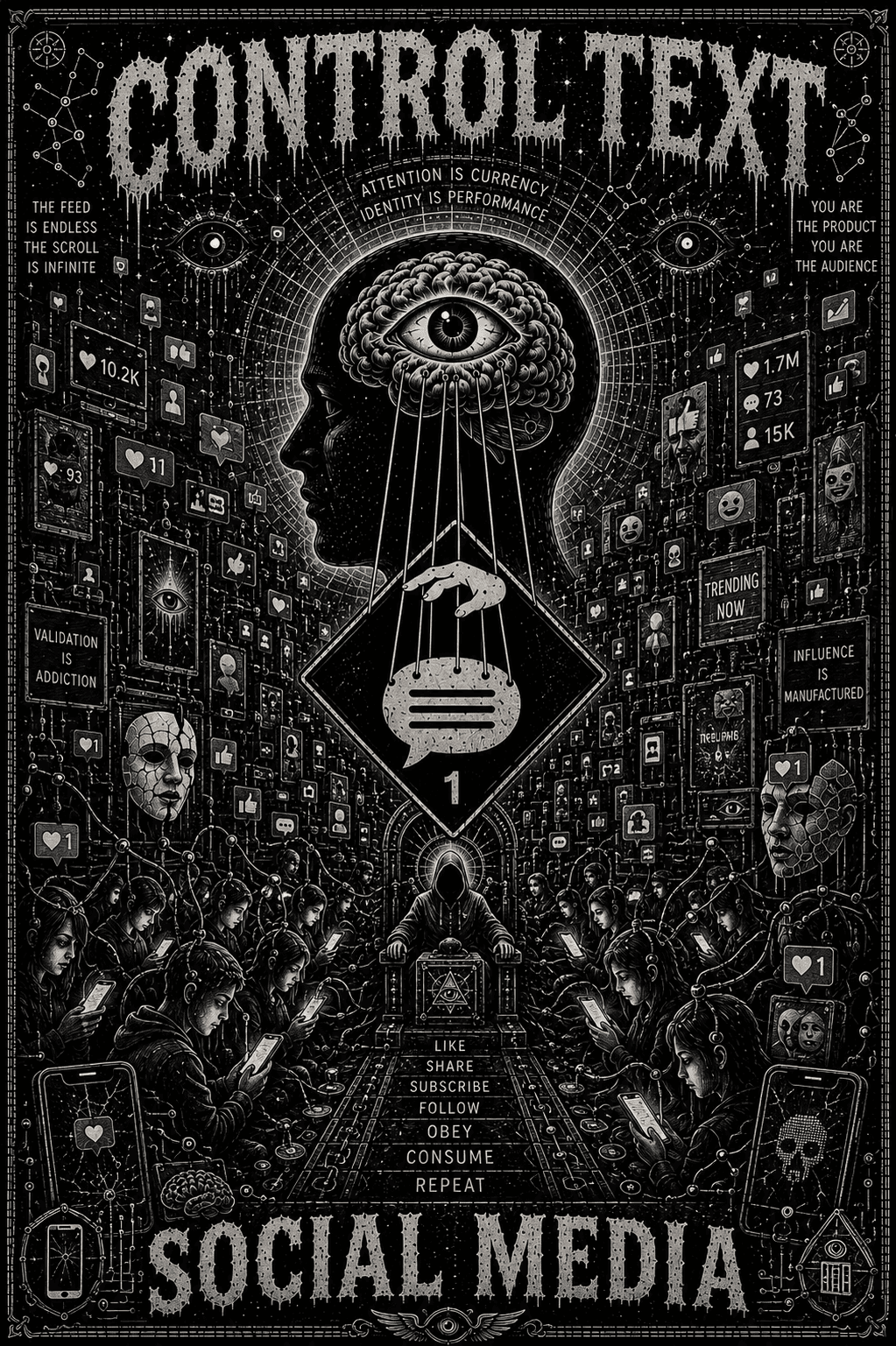
ALGORITHMIC PRIORITY (SOCIAL MEDIA)
¹ Related concepts include recommendation systems, engagement-based ranking models, predictive behavioral analytics, and algorithmic amplification.
ATTENTION CAPTURE
¹ Influenced by attention economy theory, persuasive technology design, dopamine-reward systems, and cognitive interruption research.
CONTENT CONSUMPTION
¹ Related to media saturation theory, passive informational intake, digital conditioning environments, and perception-shaping systems.
ENGAGEMENT OPTIMIZATION
¹ Influenced by platform retention engineering, variable reward reinforcement systems, and behavioral prediction models.
SOCIAL MEDIA INFLUENCE
¹ Related concepts include network effects, parasocial reinforcement, identity signaling, and digitally mediated social conditioning.
TREND ADHERENCE
¹ Associated with conformity psychology, memetic propagation, collective imitation systems, and social normalization processes.
VIRAL DISTRIBUTION
¹ Influenced by memetics (Richard Dawkins), network propagation theory, algorithmic amplification, and emotional transmission systems.
POLICY ALIGNMENT (POWERSYSTEMS)
¹ Related to institutional compliance systems, regulatory adaptation, incentive structures, and governance enforcement models.
POWER CONSOLIDATION
¹ Influenced by centralized authority theory, institutional accumulation structures, and concentration-of-power dynamics.
STRUCTURED ADVANTAGE
¹ Related concepts include systemic inequality, inherited infrastructure, institutional privilege systems, and structural reinforcement mechanisms.
SYSTEM MAINTENANCE
¹ Influenced by systems theory, entropy resistance models, institutional stabilization processes, and operational continuity structures.
CONTROLLED ACCESS
¹ Related to gatekeeping systems, authorization hierarchies, credential-based participation models, and controlled distribution structures.
POWER SURVEILLANCE
¹ Influenced by panopticism (Michel Foucault), surveillance-state theory, data monitoring systems, and predictive governance structures.
BEHAVIORAL GOVERNANCE
¹ Related concepts include social engineering, incentive-based regulation, behavioral economics, and institutional conditioning systems.
SYSTEMIC ENTRENCHMENT
¹ Influenced by institutional inertia theory, bureaucratic persistence, structural dependency systems, and reinforcement-based continuity.
TEMPORARY EXISTENCE (EXISTENTIAL)
¹ Related to entropy, impermanence in philosophy, existential temporality, and systems degradation across time.
UNKNOWN OUTCOME
¹ Influenced by uncertainty theory, probabilistic systems, incomplete-information models, and unpredictability within complex environments.
CONTINUOUS DECAY
¹ Related concepts include entropy, material degradation, biological aging systems, and progressive structural instability.
SURVIVAL PRIORITY
¹ Influenced by evolutionary psychology, survival instinct theory, adaptive threat response systems, and resource-preservation behavior.
LIMITED TIMEFRAME
¹ Related to mortality awareness, finite-duration systems, existential temporality, and irreversible progression through time.
EXISTENTIAL UNCERTAINTY
¹ Influenced by existential philosophy, phenomenology, consciousness studies, and unresolved metaphysical inquiry.
INESCAPABLE CONSTRAINT
¹ Related concepts include physical limitation systems, resource boundaries, mortality constraints, and deterministic structural conditions.
Other notable Authors & Work:
Marshall McLuhan
Understanding Media: The Extensions of Man (1964)
The Medium Is the Massage (1967)
George Orwell
1984 (1949)
Politics and the English Language (1946)
Robert Anton Wilson
Prometheus Rising (1983)
Cosmic Trigger (1977)
Quantum Psychology (1990)
Russ Kick
Everything You Know Is Wrong (1998)
50 Things You’re Not Supposed to Know (2004)
Carl Gustav Jung
Man and His Symbols (1964)
The Archetypes and the Collective Unconscious (1959)
Modern Man in Search of a Soul (1933)
Dr. Joe Dispenza
Breaking the Habit of Being Yourself (2012)
Becoming Supernatural (2017)
Rick Strassman
DMT: The Spirit Molecule (2001)
Terence McKenna
Food of the Gods (1992)
The Archaic Revival (1991)
True Hallucinations (1987)
Friedrich Nietzsche
Beyond Good and Evil (1886)
Thus Spoke Zarathustra (1883)
The Genealogy of Morals (1887)
Albert Camus
The Myth of Sisyphus (1942)
The Stranger (1942)
Leo Tolstoy
A Confession (1882)
The Kingdom of God Is Within You (1894)
Eliphas Levi
Transcendental Magic (1854)
The History of Magic (1860)
Peter J. Carroll
Liber Null & Psychonaut (1987)
Condensed Chaos (1995)
Walter Russell
The Universal One (1926)
The Secret of Light (1947)
Walter Cruttenden
Lost Star of Myth and Time (2007)
Sun Tzu
The Art of War
Hunter S. Thompson
Fear and Loathing in Las Vegas (1971)
Fear and Loathing on the Campaign Trail '72 (1973)
Jean Baudrillard
Simulacra and Simulation
Michel Foucault
Discipline and Punish
Edward Bernays
Propaganda
Guy Debord
Society of the Spectacle
B.F. Skinner
Science and Human Behavior
Daniel Kahneman
Thinking, Fast and Slow
Ivan Pavlov
classical conditioning research
Book Collection
Understanding Media — Marshall McLuhan (1964)
The Medium Is the Massage — Marshall McLuhan & Quentin Fiore (1967)
Amusing Ourselves to Death — Neil Postman (1985)
Simulacra and Simulation — Jean Baudrillard (1981)
The Society of the Spectacle — Guy Debord (1967)
Propaganda — Edward Bernays (1928)
Manufacturing Consent — Noam Chomsky & Edward S. Herman (1988)
1984 — George Orwell (1949)
Politics and the English Language — George Orwell (1946)
Propaganda: The Formation of Men’s Attitudes — Jacques Ellul (1962)
General System Theory — Ludwig von Bertalanffy (1968)
Cybernetics — Norbert Wiener (1948)
Brain of the Firm — Stafford Beer (1972)
Thinking in Systems — Donella Meadows (2008)
Man and His Symbols — Carl Gustav Jung (1964)
The Archetypes and the Collective Unconscious — Carl Gustav Jung (1959)
Psychology and Alchemy — Carl Gustav Jung (1944)
Modern Man in Search of a Soul — Carl Gustav Jung (1933)
Science and Human Behavior — B.F. Skinner (1953)
Conditioned Reflexes — Ivan Pavlov (1927)
Thinking, Fast and Slow — Daniel Kahneman (2011)
The Presentation of Self in Everyday Life — Erving Goffman (1956)
Beyond Good and Evil — Friedrich Nietzsche (1886)
Thus Spoke Zarathustra — Friedrich Nietzsche (1883)
On the Genealogy of Morals — Friedrich Nietzsche (1887)
The Myth of Sisyphus — Albert Camus (1942)
The Stranger — Albert Camus (1942)
Fear and Trembling — Søren Kierkegaard (1843)
Being and Time — Martin Heidegger (1927)
Transcendental Magic — Eliphas Levi (1854)
The History of Magic — Eliphas Levi (1860)
The Secret Teachings of All Ages — Manly P. Hall (1928)
Liber Null & Psychonaut — Peter J. Carroll (1987)
Condensed Chaos — Phil Hine (1995)
Magick in Theory and Practice — Aleister Crowley (1929)
The Archaic Revival — Terence McKenna (1991)
Food of the Gods — Terence McKenna (1992)
True Hallucinations — Terence McKenna (1987)
DMT: The Spirit Molecule — Rick Strassman (2001)
The Doors of Perception — Aldous Huxley (1954)
The Book: On the Taboo Against Knowing Who You Are — Alan Watts (1966)
The Universal One — Walter Russell (1926)
The Secret of Light — Walter Russell (1947)
Lost Star of Myth and Time — Walter Cruttenden (2007)
Discipline and Punish — Michel Foucault (1975)
The History of Sexuality — Michel Foucault (1976)
Economy and Society — Max Weber (1922)
Distinction — Pierre Bourdieu (1979)
Tragedy and Hope — Carroll Quigley (1966)
Everything You Know Is Wrong — Russ Kick (1998)
50 Things You’re Not Supposed to Know — Russ Kick (2004)
Cosmic Trigger — Robert Anton Wilson (1977)
Prometheus Rising — Robert Anton Wilson (1983)
Quantum Psychology — Robert Anton Wilson (1990)
Capitalist Realism — Mark Fisher (2009)
The Age of Surveillance Capitalism — Shoshana Zuboff (2019)
Ten Arguments for Deleting Your Social Media Accounts Right Now — Jaron Lanier (2018)
Steps to an Ecology of Mind — Gregory Bateson (1972)
Operating Manual for Spaceship Earth — Buckminster Fuller (1969)
Science and Sanity — Alfred Korzybski (1933)
Breaking the Habit of Being Yourself — Dr. Joe Dispenza (2012)
Becoming Supernatural — Dr. Joe Dispenza (2017)
Fear and Loathing in Las Vegas — Hunter S. Thompson (1971)
Fear and Loathing on the Campaign Trail ’72 — Hunter S. Thompson (1973)
A Confession — Leo Tolstoy (1882)
The Kingdom of God Is Within You — Leo Tolstoy (1894)
The Art of War — Sun Tzu (~5th century BCE)